Older Students Need Fluency in Complex Text
Teachers in grades 4-12 often ask how they can help struggling readers understand complex texts used in content classrooms. They complain that students cannot read the material in the print resources that districts have given them for content learning.
While teachers know they must improve their students’ reading comprehension skills, many do not know how to help readers understand complex texts.
They say that while they were well-trained in their content, they were not trained in how to be reading teachers.
To address this problem, teachers want ideas on how they can help their students improve their ability to read complex text in higher grades.
As children move through the grades, content reading becomes more difficult. While students may have passed their eyes over the assigned text, they finished their task with little understanding of the concepts covered in the text they have been asked to read.
Connecting to Background Knowledge Improves Comprehension
First, students may not understand what they have read due to limited background knowledge. To help students succeed in content instruction, we must activate what students already know about a subject.
We must also help students make connections between new knowledge and what they already know about a topic.
When students connect what they already know about a topic to their reading text, their comprehension increases.
Effective readers continually try to make sense of what they are reading and connect what they already know about a topic to the new information they are learning.
Previewing Helps Reading Comprehension Skills
Before students begin reading, they should understand how to preview the text and how to set a purpose for their reading. When the purpose is clear, readers know what they will be expected to do with the text.
Students are more successful When they know what they are expected to accomplish by the end of their reading.
We can also increase motivation and foster interest by helping students predict what they will learn from the text. By spending a significant amount of time “front-loading” our units, we can help students connect better with the new information they will learn.
Anticipation guides, study guides, or graphic organizers (concept maps, flow charts, KWL charts, etc.) are great ways to help students think about what they already know about a topic. These tools can help students verify their predictions and connections as a reading follow-up.
Teaching Vocabulary Helps Struggling Readers Understand Text
Reading comprehension difficulties are connected to the size of a person’s vocabulary. Poor readers often have smaller vocabularies than more proficient readers. This means they can become overwhelmed by unknown words in the text and lose understanding.
Readers cannot understand what they are reading if they do not understand what the words in the text mean. For this reason, helping students build their vocabulary storehouse is also critical.
Explicitly teach new words as these words arise in the text. Then, provide students with numerous opportunities to see and use these words.
Help students see and use their new vocabulary while reading, during classroom discussions, and in various writing activities.
Help students add new words to their active vocabularies by creating a student-friendly definition and visual cues to help them connect to the new word.
Reinforce their learning by helping students see and use their new vocabulary on multiple occasions so the words become more familiar.

Marzano’s Six Steps of Vocabulary Learning
Marzano has provided a six-step process for teachers to introduce new vocabulary words to their students.
The six steps are as follows;
1) Explain – Explain the word by providing a student-friendly definition;
2) Restate – Ask students to create a definition in their own words;
3) Show – Ask students to draw a picture, symbol, or graphic representation of the new word;
4) Discuss – Discuss the new word and help students add to their knowledge about the word;
5) Refine and Reflect – Refine word definitions with connections to other uses or similar words;
6) Apply – Play with words in games that allow students to review the meaning of words previously learned.
Increase Opportunities for Collaborative Reading in the Classroom
While many content teachers have used Round-Robin reading in the classroom, there is no evidence that it helps students improve their reading comprehension.
Round Robin reading, also known as “popcorn reading” or “popsicle stick reading,” involves students reading orally from a shared text, one child after another. During this time, the rest of the class is directed to follow along in their own copies of the text.
Round Robin reading and similar strategies force poor readers to endure embarrassment and humiliation by reading in front of the entire class.
Round-robin reading weakens the comprehension of other students in the class. Some students read too fast, while others read too slowly. Some read in a halting or interrupted manner that does not allow listeners to follow along, causing them to lose meaning.
As a student, you probably had a strategy for this in school. You probably counted ahead to see which passage you would be required to read. Then, since no one wanted to look “dumb” in front of peers, you silently practiced the passage until you were confident that you could read it fluently.
While practicing your own passage, the content another student was reading at the time was ignored. So, no learning was taking place on your part.
Round-robin reading creates stress in the classroom. It neither promotes improved reading skills nor deepens comprehension.
Collaborative Reading Practices to Help Struggling Readers
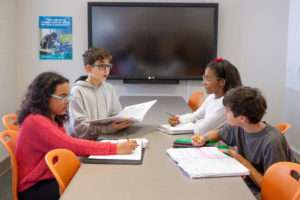
There are many collaborative ways besides Round Robin reading to help students deepen their reading skills.
Students can share information within the class through reading and presentation. Some ways to do that include Choral reading, partner reading, echo reading, and buddy reading, to name just a few.
These methods are not only more engaging but also do not evoke the level of stress in the classroom that we see with Round-Robin reading methods.
Students can present either in jigsaw “expert” groups or as a whole class presentation about their section of text. Others can ask questions to ensure they have understood the section of the text.
Struggling students are engaged when they are allowed to read more of the text themselves. They develop more fluency with practice and have a deeper level of understanding when they are allowed to interact with the text on a more extended level.
Games are also a good way to practice new vocabulary and key concepts. Formats such as Kahoot Quizzes, Jeopardy, or Who Wants to Be a Millionaire? are fun. Many versions can be found on the Internet and used in a classroom, on the Smartboard, or on a computer.
Think about the reading skills you want your students to learn in the upcoming months. What might be some ways you can deepen student motivation and enjoyment of what they will be reading?
Learn more ways to enhance your students’ reading skills. See Literacy Strategies for Grades 4-12: Reinforcing the Threads of Reading.
You Might Also Like”