Want to get your kids thinking critically more about what they are reading and processing that text at deeper levels? Then a technique called Facts, Questions, and Responses created by Harvey and Goudvis (2000) might be just the strategy you need.
Facts, Questions, and Responses to Deepen Critical Thinking
Kids of all ages can use this technique to think about and process the text they are reading. Students begin by reading a selected nonfiction text. Then they generate the facts they have identified in their reading. Students write these facts on a 3-column chart with the headings “facts” “questions” and “responses” as labels for the columns.
After writing down the facts learned, ask students to list some questions that they have about this fact or things that they wonder about. List these questions in the center column. In the third column, students write about their responses or reactions to the facts that they have learned.
This strategy can not only help students think about what is important in a selection, but it can also help them process the information. They can think about related questions that they might still have about the information in the text.
Older students can process this information on their own or with partners. Younger children can also use this strategy when guided by the teacher as a whole class activity.
Turning Questions into Paragraphs (QuIP)
A good way to help students think about what they read and increase their comprehension of the text is to use Questions into Paragraphs. Developed by McLaughlin (1987), the QuIP procedure helps students think about text both before and after reading.
Students develop or receive three related questions on the topic. They then respond to each question using at least two text sources and an appropriate graphic organizer. Once information for each question has been gathered, students synthesize the information and write one coherent paragraph summarizing the information.
First, students gather, synthesize, and summarize the information to questions that you provide. Next, they identify their related questions and complete the research, synthesis, and summarization processes on their own.
This is a great higher-order activity that promotes not only deep understanding but higher-level thinking as well.
Asking Summarization Questions to Deepen Critical Thinking
Teachers spend as much as 50% of their day asking questions. However, many of these questions are dichotomous and require lower levels of thinking.
According to Marzano et al. (2001), higher-level questions require students to apply, analyze, and evaluate concepts or create new ideas and solutions to problems. Teachers help students improve their thinking, analysis, and logic when they shift from lower-level thinking questions to asking questions that require higher levels of thinking to respond to them.
In addition to raising the cognitive level of questions you ask, you can identify what students understand as they read. Stop at key points in the text to ask questions about what is being read. One easy way to do this is to ask students to summarize the key points of a section of text.
By asking students to recall key points from the text and collaboratively create an oral or even a written summary, you help students reframe and organize information from the text.
As students listen to the meaning being summarized by other students in the class, they gain new insights and understanding. This helps clarify things that may have been unclear during the first reading of the text.
Summarizing can be done with both informational texts as well as with fictional texts. Stop at key points and ask, “Who can summarize for me what we just read in that section?” This is a great way to find out where students may have misperceptions or may have missed some key information.
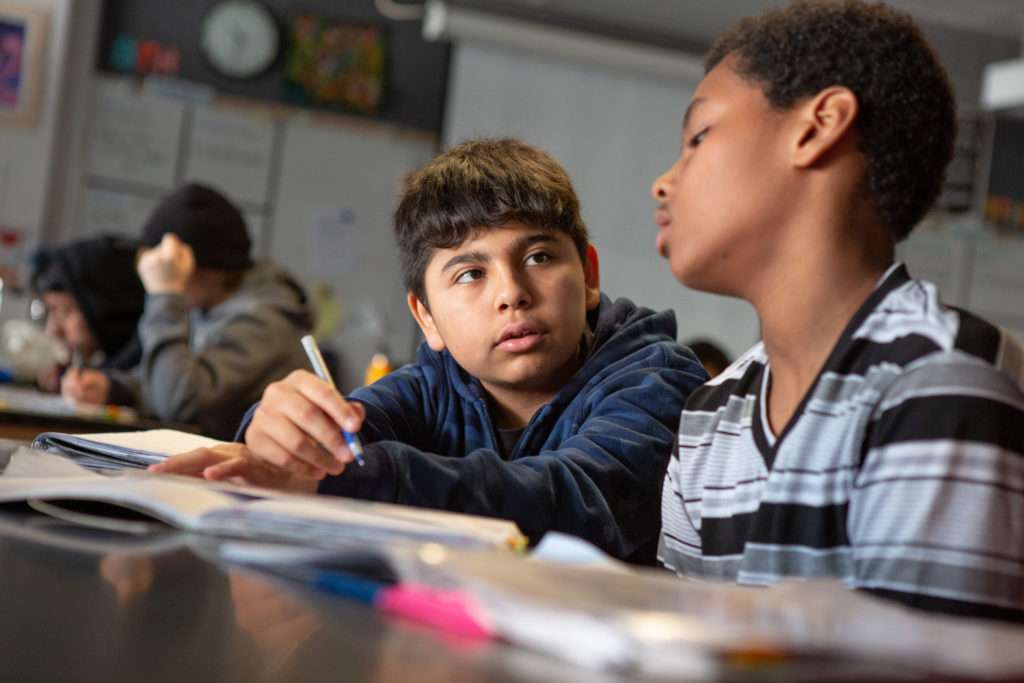
Photo by Allison Shelley for American Education: Images of Teachers and Students in Action
If you liked this post, you may like: Connecting to Deeper Meaning with Text-Based Response.
You may be interested in reading this Edutopia article from Douglas Fisher and Nancy Frey titled Questioning that Deepens Comprehension.